
White Bear Lake, MN · Garage Door Service
Why a Door Goes Off Track Here
White Bear Lake's 1960s-70s housing stock and hard winters push tracks out of alignment. Here's why it happens and what to check before you call.
- Repairs & new doors
- Springs & openers
- Serving 7 nearby communities
When to Get Help
If the door binds, jumps, or stops a few inches off the floor and won't close square, stop running the opener. Forcing a motor against a track that's bent or a roller that's jumped the rail bends the track further and can pull the bracket loose from the jamb. Most of the homes on this side of the metro went up between 1950 and 2002, with a lot of that stock clustered in the 1960s and 70s build years, which means the hardware behind the drywall is original or close to it in a good share of houses. Original brackets were fastened for the loads and the install standards of that era, not for forty-plus years of freeze-thaw cycling on the fasteners. When a door comes off track in a house that old, it's rarely a one-time fluke - it's usually the fourth or fifth small sign that the track alignment has been drifting for a while. Get it looked at before the next cold snap, because a marginal track that survives mild weather often fails during the first hard freeze of the season.
The Problem
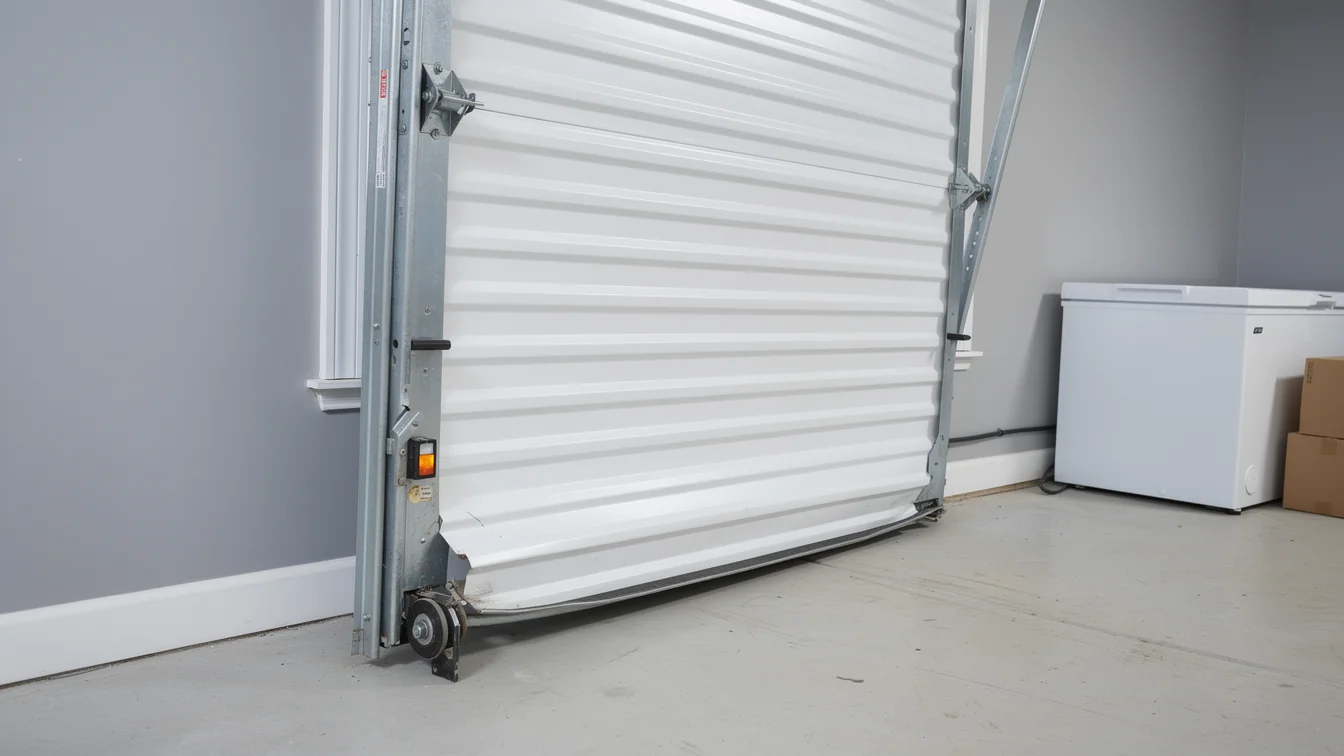
A door comes off track for a handful of mechanical reasons, and in this area the most common is a bent track from age, not abuse. Across the 1960s-70s stock that makes up a lot of the local housing, track brackets were often lag-bolted directly into jamb studs without the reinforcement plates that became standard later. Decades of expansion and contraction loosen those bolts a fraction of a turn at a time. Add a broken or unevenly wound torsion spring - common once a door hits a few decades of cycles - and one side of the door drops faster than the other, forcing a roller to climb out of the rail. Cables that have frayed at the bottom bracket do the same thing from the opposite end. None of this is dramatic until the day a roller finally clears the track and the door racks sideways in the opening. We don't recommend trying to force a racked door back onto the rail yourself; a spring still under tension can let go while you're working near it, and that's a repair, not a DIY afternoon.
What the Weather Here Does to It
This area sits in a cold, severe climate band, and that matters more to a garage door than most owners expect. Steel track contracts in deep cold, and a track bracket that's already a sixteenth of an inch loose from age pulls tighter against the stud on a ten-below night, then relaxes again on a thaw. That repeated movement is what finally walks a bracket loose enough to let the track flex under load. Torsion springs also lose some of their working tension in sustained cold, which means a spring that was barely strong enough to lift the door evenly in October can be the reason one side sags and derails in January. We see more off-track calls in the first hard cold snap of the season than any other time of year, and it's almost always a door that was already marginal going into it. Keeping the track bolts snug and the hinges lubricated before the first deep freeze is cheap insurance against a call that otherwise comes at the worst possible time.
Checking It Yourself
Before you call, you can rule a few things out safely. Close the door and look at the gap between each roller and its track - uneven spacing on one side usually points to a loose bracket rather than a bent rail. Check the bottom brackets and the lag bolts along the track for daylight between the bracket and the jamb; if you can wiggle a bracket by hand, that's your answer. Look at the cables on both sides of the door - one side slightly slack while the other is taut means a spring or cable issue, not just a track problem, and that's where we'd stop you from going further. We won't tell you to adjust spring tension yourself; it's genuinely dangerous and it's also the one repair where getting it wrong costs more than the original problem. If the track itself is visibly bent or kinked rather than just loose, straightening rarely holds for long on an older track - at that point replacing the section is usually the better money.
Frequently asked questions
Why did my garage door suddenly jump off the track after years of working fine?
Usually it's not sudden - a bracket has been working loose for years, often original hardware from the 1960s-70s building boom in this area. Add a winter cold snap that tightens and relaxes the steel repeatedly, and the last bit of play finally lets a roller climb out of the rail.
Is a bent track something I can fix myself?
Sometimes you can tighten a loose bracket back against the jamb. A genuinely bent rail is a different story - on an older track, bending it back rarely holds under daily use, and a cracked weld can fail without warning. We usually replace the bent section rather than reshape it.
Does cold weather really cause this, or is it just coincidence?
It's real. Steel track and torsion springs both respond to a cold, severe winter - metal contracts, tension drops, and any hardware that was already marginal tends to fail on the first hard freeze rather than gradually. That's why off-track calls cluster right after the season's first deep cold snap.
How do I know if it's the spring or the track that's the real problem?
Look at the cables on both sides of the door. If one side is slack while the other stays taut, the spring or cable is the root issue and the track coming off is just the symptom. If the cables look even but a bracket is loose or the rail is visibly bent, the track itself is the problem.
Related garage door services in White Bear Lake
More garage door guides
Book garage door service in White Bear Lake
Call now or request a quote - tell us what the door is doing and where you are.